
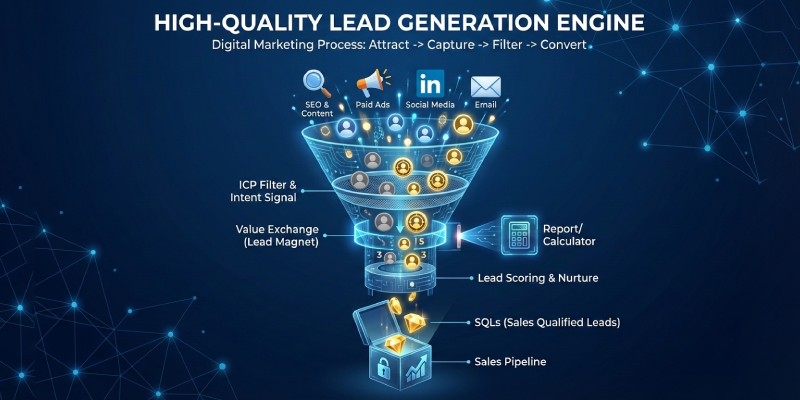
How to Generate High-Quality Leads Using Digital Marketing
Generating leads is one of the biggest challenges businesses face today, and Digital Marketing has become the most powerful way to attract potential customers online. While many companies succeed in driving traffic through ads, social media, or search engines, very few are able to generate high-quality leads—people who are genuinely interested, have a real need, and are ready to take action. The difference lies in strategy, targeting, and how effectively your message connects with the right audience.
In this blog, we'll break down proven strategies to generate high-quality leads that actually convert, not just fill your inbox.
What Are High-Quality Leads?
High-quality leads are potential customers who:
- Have a real problem your service or product solves
- Match your ideal customer profile
- Are actively looking for a solution
- Have the intent and budget to move forward
Unlike cold leads, these prospects require less convincing and shorter sales cycles.
Step 1: Clearly Define Your Ideal Customer
Before running campaigns or creating content, you must know who you're targeting.
Ask yourself:
- What industry do they belong to?
- What is their job role or business size?
- What problems are they facing?
- What solutions are they already searching for?
Create a Simple Buyer Persona
Include:
- Age range
- Location
- Pain points
- Buying motivation
- Decision-making authority
When your message speaks directly to one person, lead quality improves automatically.
Step 2: Build Landing Pages That Convert
Sending traffic to your homepage won't generate quality leads. You need dedicated landing pages designed for one purpose only—conversion.
Key Elements of a High-Converting Landing Page
- Clear headline addressing a specific problem
- Short and focused content (no distractions)
- Strong call-to-action (CTA)
- Minimal form fields (name, email, phone)
- Trust signals (reviews, testimonials, certifications)
Avoid vague CTAs like "Submit".
Use action-based CTAs like:
- "Get a Free Consultation"
- "Download the Guide"
- "Request a Quote"
Step 3: Use Content to Attract Intent-Driven Leads
Content attracts people who are already searching for solutions.
Instead of promotional posts, create content that educates and solves problems.
High-Intent Content Ideas
- How-to guides
- Comparison articles
- Problem-solution blogs
- Industry-specific case studies
- FAQs based on real customer queries
This approach positions your brand as an expert and builds trust before the first conversation.
When users feel helped, not sold to, they convert willingly.
Step 4: Leverage Paid Ads with Smart Targeting
Paid ads can deliver quick results—but only when done strategically.
Best Practices for High-Quality Lead Ads
- Target specific interests, job roles, or behaviors
- Use problem-focused ad copy, not generic promises
- Send traffic to relevant landing pages, not homepages
- Test multiple creatives and headlines
Tips to Improve Lead Quality
- Add qualifying questions in lead forms
- Use price hints to filter non-serious users
- Exclude irrelevant audiences
This ensures only serious prospects submit inquiries.
Step 5: Optimize Lead Forms to Filter Quality
More form fields don't mean better leads—but smart questions do.
Examples of Qualifying Questions
- "What is your monthly budget?"
- "What service are you looking for?"
- "When do you plan to start?"
These questions help filter out casual browsers and attract decision-makers.
Step 6: Use Email Marketing for Lead Nurturing
Not all leads convert immediately. Some need time, information, and reassurance.
Email marketing helps you stay connected without being pushy.
Effective Lead Nurturing Emails
- Welcome email explaining what to expect
- Educational emails solving specific problems
- Case studies or success stories
- Limited-time offers or consultations
Consistency builds familiarity—and familiarity builds trust.
Step 7: Retarget Warm Audiences
Many users visit your website but don't convert on the first visit. Retargeting helps bring them back.
Retargeting Works Because:
- Users already know your brand
- Interest level is higher than cold traffic
- Conversion cost is usually lower
Retarget users who:
- Visited your landing page
- Watched your videos
- Clicked ads but didn't convert
This step significantly improves lead quality and ROI.
Step 8: Track, Analyze, and Improve
If you're not tracking performance, you're guessing.
Metrics That Matter
- Conversion rate
- Cost per lead
- Lead-to-customer ratio
- Bounce rate
- Time on page
Analyze what's working and double down on it.
Eliminate campaigns that bring traffic but no conversions.
Step 9: Focus on Trust and Credibility
People don't buy from businesses they don't trust.
Ways to Build Trust Online
- Show real testimonials
- Display certifications or partnerships
- Use professional design and clear messaging
- Provide transparent pricing or processes
Trust directly impacts lead quality—more than ads or traffic.
Step 10: Combine Organic and Paid Strategies
The best results come when organic efforts support paid campaigns.
- Blogs support ads
- Social proof supports landing pages
- Email supports long-term conversions
This balanced approach makes Digital Marketing more effective and sustainable.
Common Mistakes That Reduce Lead Quality
Avoid these mistakes if you want better leads:
- Targeting everyone instead of a niche
- Using generic messaging
- Sending traffic to irrelevant pages
- Ignoring follow-ups
- Not qualifying leads early
Fixing just one of these can improve results dramatically.
Final Thoughts
High-quality lead generation is not about hacks or shortcuts.
It's about clarity, relevance, and value.
When you:
- Understand your audience
- Communicate clearly
- Offer real solutions
- Build trust at every step
You attract leads who are ready to convert—not just curious.
By applying these strategies consistently, Digital Marketing becomes a predictable system for growth, not an expense.